
AhlulBayt News Agency (ABNA): ﴾And whoever
dispute with you concerning him, after what has come to you of
knowledge, say: 'Come! Let us call our sons and your sons, our women and
your women, and our selves and your selves, then let us invoke in
earnest and lay the curse of Allah upon the liars.﴿
Commentary:
This
holy verse, because of containing the phrase /nabtahel/ in its Arabic
text, is known in Islamic literature as the verse of 'mutual Cursing',
/mubahilah/ The Arabic term /mubahilah/ means: to leave the personal
tendencies and attracting the attention towards invocation and
supplication before Allah (s.w.t.) for asking curse and perdition unto
the one who is not right.1
In commentary books from both Sunni
and Shi'ah school of thought as well as in some books of tradition and
history books, it is cited that in the tenth year A.H., from the side of
the Prophet (peace be upon him and his household), some Muslims were
commissioned to go to Najran, a region in Yemen! in order to preach
Islam The Christian inhabitants of Najran set out a religious mission
from their side to attend Medina and discuss with the prophet of Islam
(peace be upon him and his household).
After some debates and
disputes between them and the Prophet (peace be upon him and his
household), they felt hesitation and sought for pretexts. Then, this
verse was revealed, stating:
﴾And whoever disputes with you
concerning him, after what has come to you of knowledge, say: 'Come!
Let us call our sons and your sons, our women and your women, and our
selves and your selves, then let us invoke in earnest and lay the curse
of Allah upon the liars.﴿
That is, any curse which would
reach either of two parties showed that that party was not right. Thus,
the revelation of this verse put an end to that discussion thereby.
As
soon as the missionaries of the Christians of Najran heard the
suggestion of performing the mutual curse from the Prophet (peace be
upon him and his household) looked at each other while they were
surprised They asked the Prophet of Islam (peace be upon him and his
household) for respite to contemplate and consult over the subject.
Then, when they were dismissed from the presence of the Messenger of
Allah, they began consulting with each other The Chief Monk, the Leader
of the selected holy group of the Christians told them that they could
accept the suggestion. Then, if the Prophet of Islam (peace be upon him
and his household) came for cursing with ceremonies and followed by a
large group of people, they would not be worried about it and knew that
nothing might happen.
But, if they saw that he came to the spot with a few people, they would give up the act of /mubahilah/ and compromise with him.
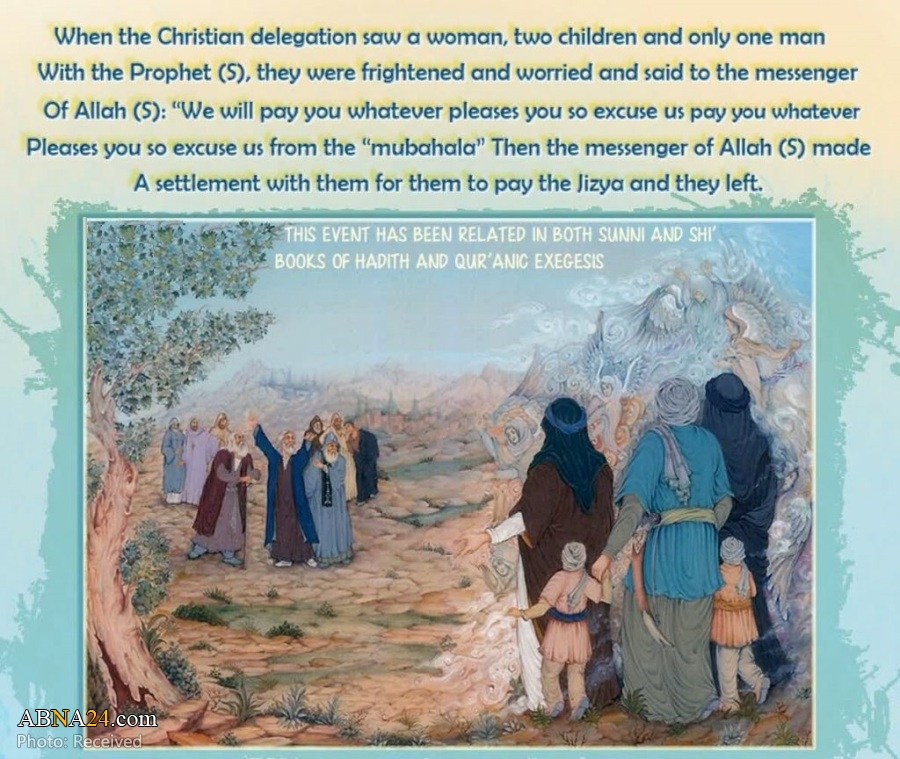
On
the day of cursing, they saw that the Prophet of Islam (peace be upon
him and his household) entered the appointed spot followed by two boys, a
young man and a lady. Those two boys were Hassan and Hussein, (a.s.)
the young man was Ali-ibn-Abitalib (a.s.), and the lady was Fatimah
(a.s.), the Prophet's daughter.
When the Chief Monk saw them, he exclaimed:
"By
God! I see the faces that, if they pray to God for mountains to move
from their places, the mountains will immediately move."
"If they curse you, you will be wiped out of existence to the last day of the life of the earth."
Therefore,
the Christians asked Muhammad (peace be upon him and his household) to
give up the idea of the agreed /mubahilah/ (mutual cursing) and they
announced they were ready for compromise. They offered to pay two
thousand suits ach of which cost, more or less, at forty dirhams
(drachma) every year (in addition to some other things)... .
This event is cited in commentary books of both great sects of Islam: Sunnites and Shi'ites.2
According
to some of the Islamic traditions, the day of Mubahilah (mutual curse)
was the twenty fourth or twenty fifth day of Zil-Hajj, and its place, at
the time of the holy Prophet (peace be upon him and his household) was
somewhere outside of Medina which has located inside the city now. At
this place, there has been built a mosque by the name of
Masjid-ul-'Ijabah which is about two kilo meters far from the Holy Tomb
of the Prophet (peace be upon him and his household) in Masjid-un-Nabiy.
'Mutual
curse' /mubahilah/ was not confined to that time. Some of Islamic
traditions indicate that every believer can apply it, too, if the one
wishes. In Nur-uth-ThaqaIayn, vol. 1, p 351 a tradition from Imam Sadiq
(a.s.) is narrated upon this subject who has issued a few instructions
about it.
In Usul-Kafi, vol 2, section ' mutual curse ', there
are also cited five traditions which denote that every believer can
apply 'mutual curse' with the opponents, too, by improving oneself
through observing the fast for three days. Its order is such that: at
twilight he puts his right hand fingers in his opponent's fingers and
recites the concerning special supplication.
There may arise a
question that when Fatimah (a.s.) was the only woman attended in that
event, why does the Qur'an has applied the plural form of the word; "
nisa'ana " (our women)? The answer is that there are some examples of
this specimen in the Qur'an where Allah refers to a single person in the
form of plural, like Sura Al-I-Imran, No 3, verse 181 wherein Allah
(s.w.t.) says: ﴾... those who say: 'God is poor...﴿ while
only one Jewish person had said that aspersive sentence. Or, the Qur'an,
referring to Abraham (a.s.) as an Ummah in himself standing alone
against his world, says:
﴾Abraham was indeed a model, ... ﴿ 3
Explanations:
1.
Ali-ibn-'Abitalib (a.s.) has been counted as the 'self ' of the
Messenger of Allah (peace be upon him and his household): "Our selves"
2. When logic, reasoning, and miracle do not make a person accept the Truth, he must be threatened to destruction.
3. The last winning means and the forceful weapon of a true believer is supplication.
4. If you stand firm, the enemy, because of not being right, will retreat.
5.
By that great event, the Lord and the Messenger of Allah (peace be upon
him and his household) made us understood that these holy persons were
the assistants and the associates of the Messenger of Allah (peace be
upon him and his household) in inviting people to the Truth and to his
sacred goal. They, following him, were ready to face with dangers, and
continued the path of his movement.
______________________________________________
1- Majma'-ul-Bayan, vol. 702, P. 452
2-
The author of Al-Mizan has cited in his commentary hook, Al-Mizan, vol
3, P 257 that this event has been reported similarly by 51 Companions of
the Prophet. Also, in commentary books by Fakhr- Razi, Aloosi, Maraqi,
and in Kitab-ul-kamil, by Ibn-'Athir, Vol 2, P. 293, in Mustadrak
Hakim,vol.
3, P.150, in Musnad Ahmad-ibn-Hanbal, vol One, P.185,
and also in Ruh-ul-Bayan,Al-minar, Commentary of Ibn-Kathir, and in many
other Islamic sources, this event has been recorded and it has been
confirmed that the Messenger of Allah, (peace be upon him and his
household) Ali-ibn-'Abitalib, Fatimah Zahra, Hassan and Husayn (a.s.)
were the ones whose prayers were answered This is a worthy document
evidence for the greatness and magnificence of Ahlul-Bayt (a.s.) In
Ihghagh-ul-Hagh, vol 3, p 49 the names of 61 respected people from the
Sunnis school of thought are mentioned who all said this verse is on the
greatness of the holy Prophet (peace be upon him and his household) and
his Ahlul-Bayt (a.s.)
3- Sura Nahl, No. 16, verse 120
/129
1 July 2024 - 08:14
News ID: 1468901
﴾And whoever dispute with you concerning him, after what has come to you of knowledge, say: 'Come! Let us call our sons and your sons, our women and your women, and our selves and your selves, then let us invoke in earnest and lay the curse of Allah upon the liars.﴿